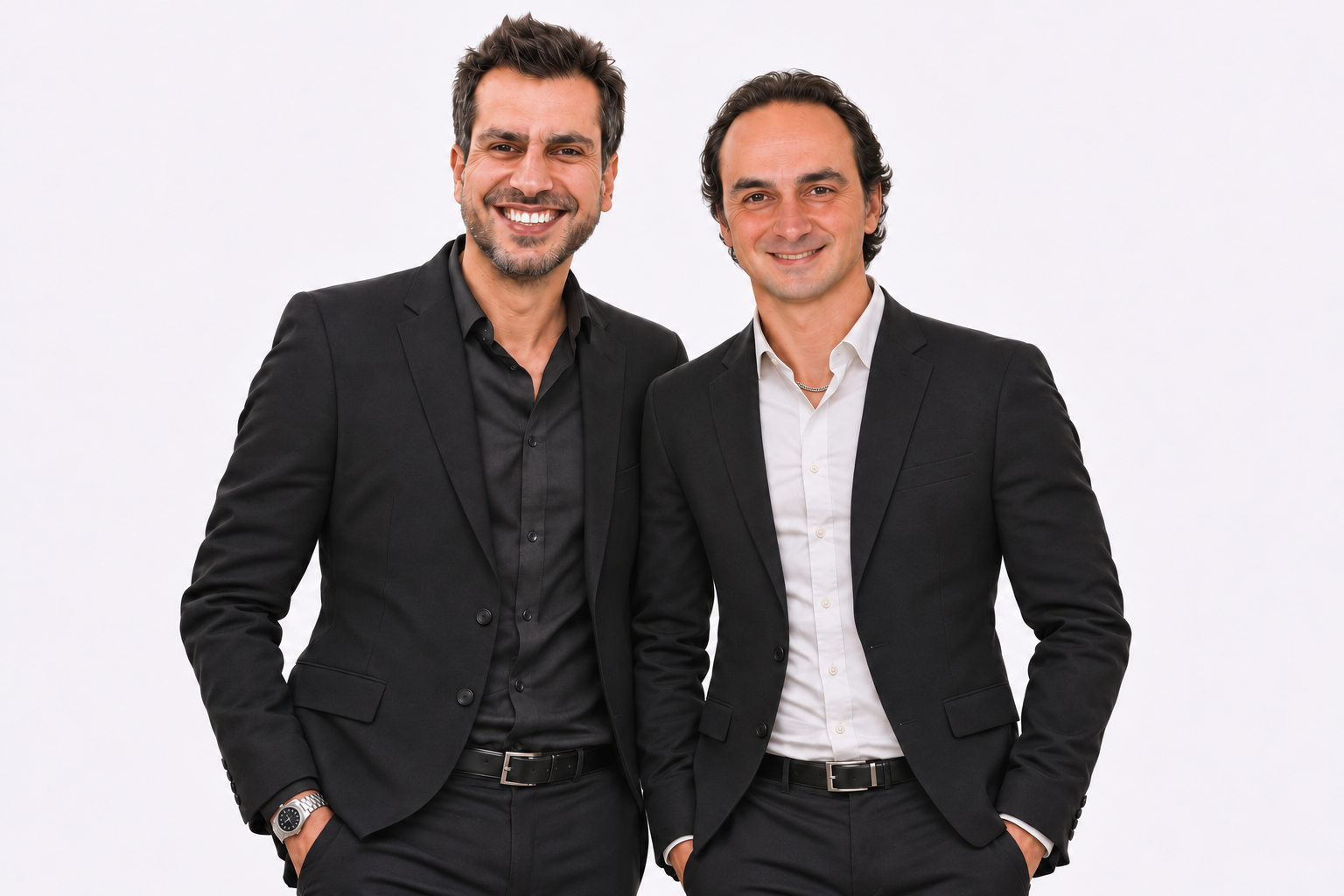
Amir Ebrahimi and Mehdi Joud. Photographer: Hooman Vafaeian
ZARVAN started in 2023 and is a part of ESA BIC Sweden. They are building AID, a platform that turns satellite data into monitoring and early warnings for landslides, ground movement, flood risk and forest health.
We spoke with Mehdi Joud at ZARVAN about its pilots and pending funding decisions, the company’s plans for a seed round in 2027 and why Sweden risks falling behind in using space technology.
“It started on a summer day in 2023. I had made some new findings in my research, and a few business owners had approached me with offers to build something around them. My co-founder Amir Ebrahimi and I were talking through these ideas when he simply asked: why don't we do it ourselves? That was the beginning of ZARVAN”, says Mehdi Joud.
ZARVAN isn't just connected to space. It's built on space technology, more precisely on satellites. We make satellites good for the planet, for people and for the economy.
But we're not about using satellite data for one or a few applications. Our platform, AID, is about orchestrating satellites towards reliable, fast and accessible solutions for various needs. These include monitoring and early warning systems for geohazards such as:
- landslides
- mine collapses
- ground movement under roads and railways
- water and flood risk
- forest health.
A user describes the problem, and AID works out which satellite data and analysis are needed and turns them into answers people can act on.
What have you been up to since you started your incubation with ESA BIC Sweden?
Mainly building the platform. AID is a complex system that combines multimodal sensors, signal processing and scientifically justified methods, and getting that right takes time. Then came the AI boom and with it rising computation costs. That changed our early projections and we had to spend time adapting to the new situation.
But we succeeded. We now have good pilots and partners, such as municipalities and large consultancy companies in Sweden and a couple of agencies abroad.
Alongside the product, we've worked hard on applications to take the technology further. These include AID-Infra, a joint proposal with KTH to the Swedish National Space Agency on AI for infrastructure risk, as well as ESA proposals for forest biomass monitoring, the water sector and high-performance computing.
The hardworking team behind ZARVAN is Mehdi Jound, his co-founder Amir Ebrahimi and the founder board with Renan Ferreira from AMAON SAR, Per Andersson from Gävle Innovation Byrå and Vinud Kampurne from Pandora.
What’s in the pipeline for ZARVAN right now?
A lot is happening. We're waiting for the decision on AID-Infra from the Swedish National Space Agency, expected this month (November 2026), with a project start in January 2027, if it's funded. Together with Sweco, we're exploring satellite monitoring for new road and railway projects, and possibly ground movement around mines. We're also preparing a water-sector proposal to ESA.
On the product side, we're developing AID-Mission, which automatically orders the right satellite data for a customer's project, including high-resolution commercial radar. We're in talks with satellite operators about this. We also have pilot discussions abroad, including in Brazil.
We plan to open a seed round in March 2027 to turn our pilots into recurring customers and grow the team.
In 2027, ZARVAN will also host IEEE GRSS activities in Uppsala. I invite everyone to follow our website for upcoming events.
What thoughts do you have about the space industry in Sweden now and in the future?
Sweden has a strong foundation in space: excellent research, launch capability at Esrange and real national commitment. But when it comes to using satellite data, we're falling behind. Countries like the Netherlands and Germany already use satellite monitoring routinely for their infrastructure. Here, the data and methods exist, but they're not being used.
The problem isn't technology. It's mindset. Decisions are too often made far from the expertise and trust in specialists is low. With HR, old-fashioned administration and fika breaks alone, we won't find a seat on the express train of the satellite business.
The demand is there, from infrastructure, mining, water and climate adaptation. The question is whether Sweden takes its seat or watches the train leave.
What advice would you give to other startups that are thinking about joining the space industry or applying to ESA BIC Sweden?
Don't do it, unless you're ready for it. Space is not a quick win. Building on satellite technology takes deep expertise, patience and more time and money than you expect. But if you have a real problem to solve and the stamina to stick with it, go for it.
Building has become much cheaper and more realistic than when we started. New ideas come out every day, and they reach the market far faster than before. So having a good product is no longer the turning point. What matters is that the product really works, that it's validated and that it sells. Finding a commercial route is the winning point.
My advice: talk to real customers from day one, not only to engineers and funders. A great technology is worth nothing until someone uses it and pays for it.
And apply to ESA BIC Sweden. It gives you credibility, structure and a network that's hard to build alone.
What has been the most valuable part of being a part of ESA BIC Sweden?
The most valuable part has been credibility and structure. Having ESA BIC behind us opens doors with partners, agencies and customers, both in Sweden and abroad.
The programme also forced us to turn a broad vision into a working product with clear milestones. And the honest feedback we received, even when it was tough, pushed us to focus on what really matters: real customers and validated results.
Add the network of people and fellow startups, and you have support that's very hard to build on your own.