Space innovation isn't just about satellites - it's also about people - Glenn Bilby, Qinematic Space
The new ESA BIC Sweden inbubatee Qinematic Space is using movement intelligence and biomechanics to support astronaut health, performance and mission readiness, while creating solutions with impact far beyond space. Meet the founding CEO Glenn Bilby in this interview.
How and when did your journey begin as a startup, working with space-related technology?
Qinematic’s journey into space-related technology grew very naturally from our long-standing work in advanced human motion capture and biomechanics. For more than a decade, Qinematic has been developing and validating motion capture technologies for health, fitness, sports and performance environments. A couple of years ago in Paris, some scouts from ESA discovered us at an AI for Health event. Around this foundation, we saw a clear alignment with the challenges of human health, performance and resilience in space.
Our engagement with ESA allowed us to develop a technology that meets the unique demands of spaceflight. We decided to spin out Qinematic Space as a focused venture.
What does Qinematic Space do and what is the long-term goal and hopes?
Qinematic Space develops advanced, data-driven motion analysis and digital human assessment technologies to support astronaut health, performance and mission readiness.
Our long-term goal is to help create a future where objective movement intelligence is a standard tool for protecting human health – not only in space, but also on Earth.
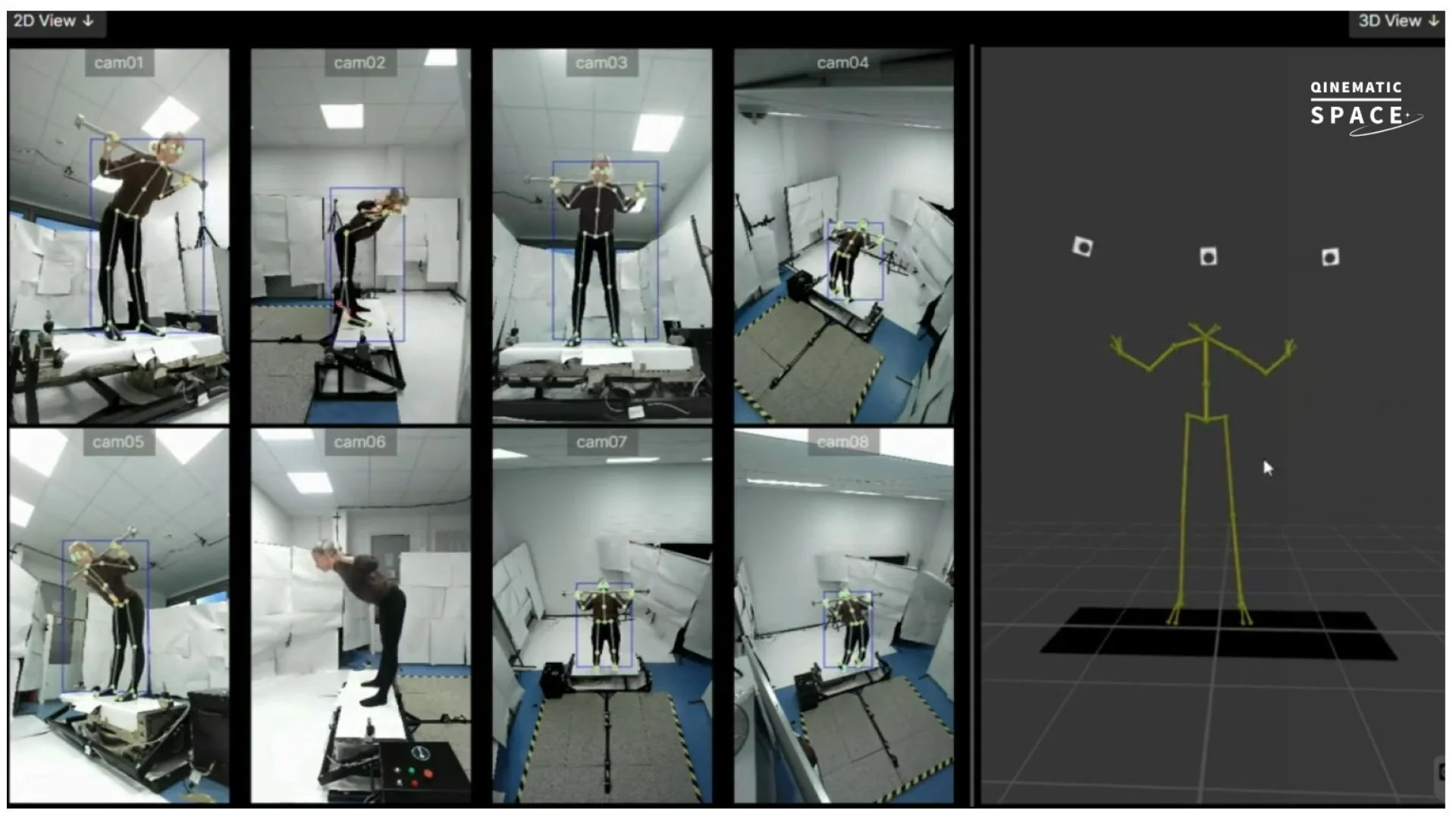
We believe that investments made for space exploration can and should translate into scalable solutions for healthcare, rehabilitation, healthy ageing and high-performance populations globally. Our immediate focus is to continue developing a multicamera movement assessment system and try to make it as autonomous as possible for hyper personalised training and remote monitoring.
What have you been up to since you started your incubation with ESA BIC Sweden?
Qinematic Space is a new-comer to ESA-BIC. It was very exciting to join the recent ESA-BIC Baltic event in Stockholm. We are focussed on strategic collaboration right now and actively looking for local partners in Sweden. Qinematic has been actively involved in developing motion capture technology for ESA, while also seeing strong international interest from organisations such as NASA and the Canadian Space Agency (CSA).
Although, still in pilot mode, our prototype systems have been used to scan and analyse astronaut movement, with the aim to provide valuable insights into physical performance and musculoskeletal health. In the near future, we have to strengthen our commercial and regulatory readiness to ensure our solution is robust, validated and scalable.
What is in the pipeline for you now?
We still have a lot of technical development ahead of us. Computer vision technology is improving quickly, as are the opportunities with augmented intelligence. If the funding becomes available we would like to work with some academic partners in Sweden - combining biomechanics with machine learning. In the meantime, we have to strengthen our commercial and regulatory readiness to ensure our solution is robust, validated and scalable. Looking a bit further ahead, we intend to focus on expanding deployments within space-related programmes focussed on terrestrial health and performance. Microgravity is harsh on the human body and not all astronauts are athletic when they come into the training program and they are not quite themselves physically when they return from a mission.
We will look for opportunities for broader collaborations across space agencies, research institutions and industry partners. We are particularly excited about the role our technology can play in long-duration missions and preventative health strategies.
What do you think of the space industry in Sweden right now and in the future?
Sweden’s space industry is in a very exciting phase, and I hope Qinematic Space can take some of the attention off satellites, rockets and communications and shine the light on human-focused technologies alongside traditional engineering. Sweden has a thriving Life Science sector, and we have afoot in both doors. With strong academic foundations, progressive public support and initiatives like ESA BIC Sweden, the ecosystem is well positioned to produce globally relevant innovation. Looking forward, I see Sweden and Qinematic Space playing an increasingly important role in human spaceflight, health and life sciences connected to space.
What advice would you give to other startups thinking about joining the space industry or applying to ESA BIC Sweden?
My advice would be to think long-term and human-centric. Space is demanding, but it is also one of the most powerful innovation environments imaginable. ESA BIC Sweden is a stepping stone with some funding, but more importantly - credibility, structure and access to a unique network.
Be clear about the real problem you are solving, be open to collaboration and understand that solutions developed for space often have profound impact back on Earth.
What has been the most valuable part of being in ESA BIC Sweden?
So far it has been credibility. Our journey has just begun, but I expect a relationship built on trust, expertise and perspective. ESA BIC Sweden is the doorway to connecting with stakeholders who truly understand the complexity of space innovation.
ESA BIC Sweden understands that investment in human health and performance is essential – both for space exploration and for society at large.